
A Phoenix small business evaluating managed IT services should generally plan for approximately $150-$200 per user per month for full Standard Managed Services. For businesses that need a more limited cybersecurity and IT support foundation, OnSite Tech's Essentials plan is approximately $100 per billable unit per month, where the billable unit is the greater of the user count or device count.
For a 10-, 15-, or 25-employee company, that gives you a useful starting point for building an IT budget. Actual investment varies based on your users, devices, infrastructure, cybersecurity requirements, locations, Microsoft environment, and the operational responsibilities your IT provider will manage.
These figures are planning guidance, not guaranteed quotes.
What Does Managed IT Cost for a 10-, 15-, or 25-Employee Business?
Using OnSite Tech's public planning ranges, here's a simple way to estimate recurring costs before your environment has been formally scoped.
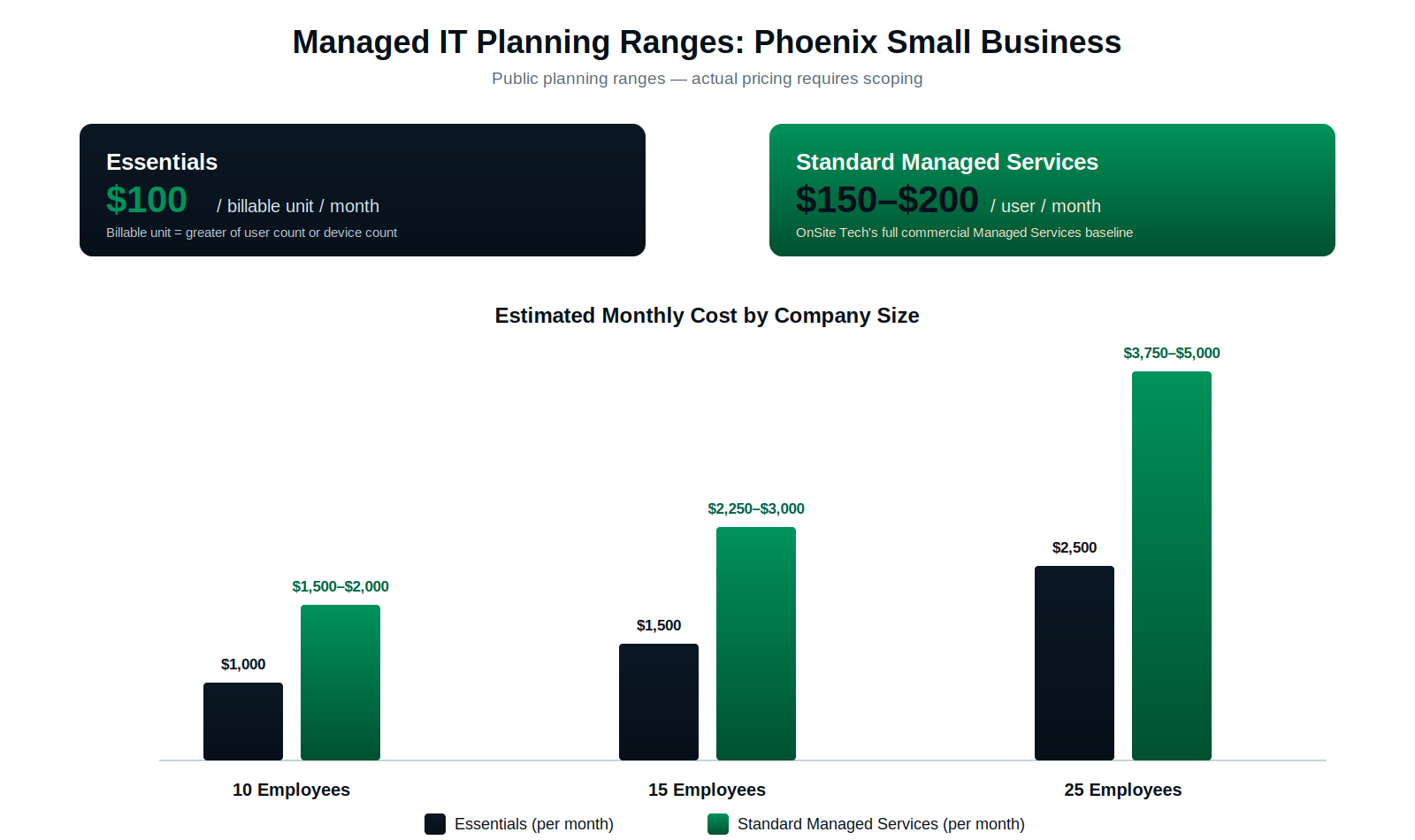
| Company Size | Essentials* | Standard Managed Services |
|---|---|---|
| 10 employees | Starting around $1,000/month | Approximately $1,500-$2,000/month |
| 15 employees | Starting around $1,500/month | Approximately $2,250-$3,000/month |
| 25 employees | Starting around $2,500/month | Approximately $3,750-$5,000/month |
*Essentials is $100 per billable unit per month. The billable unit is the greater of the number of users or devices. A business with more devices than employees would have a different estimate than the examples above.
Microsoft 365 licensing is separate from the Essentials base service.
These examples are intended for budgeting. Your actual service requirements must be scoped before determining a final price.
1. Start With the Number of Users and Devices
Company size is one of the easiest starting points for estimating managed IT costs, but employee count does not tell the whole story.
Consider two Phoenix businesses that each employ 15 people. One could have 15 employees working primarily from laptops with cloud applications. Another could have 15 employees, 25 computers and devices, on-premises infrastructure, specialized applications, and more complicated networking requirements.
Those environments do not necessarily require the same amount of ongoing IT management. Important factors can include:
- Number of users
- Number and type of devices
- Number of business locations
- Network complexity
- Microsoft environment
- Servers and other infrastructure
- Security requirements
- Support requirements
That's why employee count provides a useful budgeting starting point rather than a final quote.
2. Decide How Much Operational Responsibility You Want Your Provider to Carry
One of the most important questions when comparing managed IT pricing is not simply how many cybersecurity tools you get.
A better question: "What IT and cybersecurity responsibilities is the provider actually taking responsibility for?"
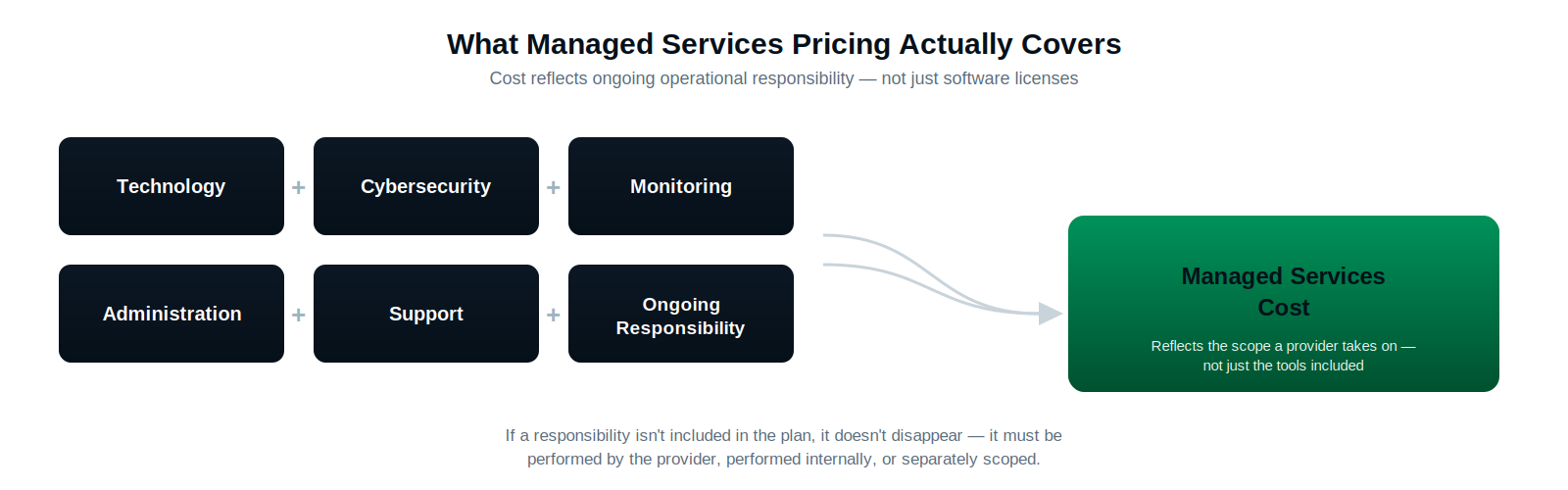
Software alone does not administer, secure, monitor, maintain, and back up your business environment. Those activities require ongoing operational work.
If a responsibility is not included in a Managed Services Program, it does not disappear. The work must be performed by the provider, performed internally by your business, separately scoped, or it risks not being performed consistently.
This distinction can also explain why two IT companies quote substantially different monthly prices. A lower monthly price may simply represent a different scope of operational responsibility. When comparing providers, identify what each provider will manage, what is separately billed, and what remains your company's responsibility.
3. Decide Whether Essentials or Standard Managed Services Fits
OnSite Tech offers different levels of service because not every small business needs the same operational scope.
Essentials: Approximately $100 Per Billable Unit/Month
Essentials is designed for businesses that need a foundational cybersecurity and IT support program but do not require the operational scope of full Managed Services. It is a deliberately limited service tier rather than a discounted version of Standard Managed Services.
The service is focused on:
- Foundational cybersecurity
- Microsoft 365 administration
- Limited IT support
- Cloud and endpoint environments
- Business-hours support
On-premises infrastructure is not included in the base Essentials scope, Microsoft 365 licensing is separate, and Essentials is not a compliance service tier.
For a business with 10 users and 10 devices, a simple planning estimate would be approximately $1,000 per month.
Standard Managed Services: Approximately $150-$200 Per User/Month
For budgeting purposes:
- 10 users: approximately $1,500-$2,000/month
- 15 users: approximately $2,250-$3,000/month
- 25 users: approximately $3,750-$5,000/month
Actual investment depends on the environment and operational scope.
The important distinction is that you're evaluating a broader ongoing management relationship rather than simply purchasing additional IT products.
4. Identify Costs That May Be Separate From Recurring Managed Services
Another common mistake is assuming that every technology expense is included in a managed IT per-user price. A more useful budgeting framework separates IT spending into three layers.
Layer 1 - Recurring Managed Services
Administration, monitoring, support, security operations, maintenance, and other recurring operational responsibilities.
Layer 2 - Licensing and Architecture-Specific Costs
Microsoft 365 licensing, architecture-specific subscriptions, and other specialized technology requirements.
Layer 3 - Projects and Periodic Work
Onboarding, migrations, major remediation, tenant restructuring, significant infrastructure changes, and other separately scoped projects, including backup and disaster recovery planning.
Ask prospective providers to explain these categories clearly when comparing prices. A monthly managed services number is much more useful when you know exactly what it does and does not cover.
5. Compare IT Providers by Scope, Not Price Alone
Suppose Provider A quotes $100 per user and Provider B quotes $175. That comparison does not tell you which provider offers better value. First determine whether you're comparing equivalent scopes.
Use this five-question framework:
- What operational responsibilities are included?
- What cybersecurity responsibilities are included?
- What remains our company's responsibility?
- What services, licensing, and projects are billed separately?
- How will the provider help us manage technology as the business changes?
For a small business, the objective shouldn't necessarily be finding the lowest monthly number. It should be understanding the responsibilities your business needs covered, then comparing providers based on that scope.
Representative Example: A 15-Employee Phoenix Business
Using the planning ranges above, the business might initially compare approximately $1,500 per month for an Essentials-level service with approximately $2,250-$3,000 per month for Standard Managed Services. Looking only at those numbers makes the lower price seem like the obvious choice.
But the more useful conversation is about scope. Does the company simply need a cybersecurity and support foundation, or does it want its provider to carry broader responsibility for managing its technology environment?
Once the business defines the responsibilities it expects an IT provider to perform, it can determine which service model is the better fit.
This is a representative scenario for planning purposes, not an actual client result or quote.
What Should a Phoenix Small Business Budget for Managed IT?
For a 5-25 employee Phoenix business, a useful starting framework is:
- Essentials: approximately $100 per billable unit/month
- Standard Managed Services: approximately $150-$200 per user/month
- 10-user Standard example: approximately $1,500-$2,000/month
- 15-user Standard example: approximately $2,250-$3,000/month
- 25-user Standard example: approximately $3,750-$5,000/month
Use those figures to establish an initial budget, then evaluate the environment and operational responsibilities required.
The most important question isn't simply "How much does managed IT cost?" It's "What responsibilities are included for that price?"
Frequently Asked Questions
How much does IT support cost for a 10-person company in Phoenix?
For full Standard Managed Services, a 10-user company can use approximately $1,500-$2,000 per month as initial planning guidance. A limited Essentials service begins at approximately $100 per billable unit per month. Actual pricing requires scoping.
How much does managed IT cost for a 15-person business in Phoenix?
For full Standard Managed Services, a 15-user Phoenix business can use approximately $2,250-$3,000 per month as initial planning guidance, based on a planning range of $150-$200 per user per month. Actual pricing depends on the environment, requirements, and scope.
How much should a 25-person business budget for managed IT?
Using the Standard Managed Services planning range of $150-$200 per user per month, a 25-user company can initially budget approximately $3,750-$5,000 per month for recurring Managed Services.
Why do two managed IT companies quote different prices?
Different prices may represent different scopes of operational responsibility. Compare what each provider administers, monitors, secures, maintains, and supports, along with what's excluded or separately billed.
Is Microsoft 365 licensing included?
Microsoft 365 licensing is separate from OnSite Tech's Essentials base service. Businesses should confirm licensing and architecture-specific costs as part of their overall IT budget.
Is $150-$200 per user a guaranteed price?
No. It is a public planning range intended to help businesses establish realistic budgets. Actual proposals depend on the organization's environment, requirements, and scope.
Know What You're Buying Before You Compare Prices
OnSite Technical Services helps Phoenix-area businesses understand their technology, cybersecurity needs, and operational requirements before determining the appropriate service scope.
Request a scoping conversation
Planning guidance only. Pricing requires scoping.